



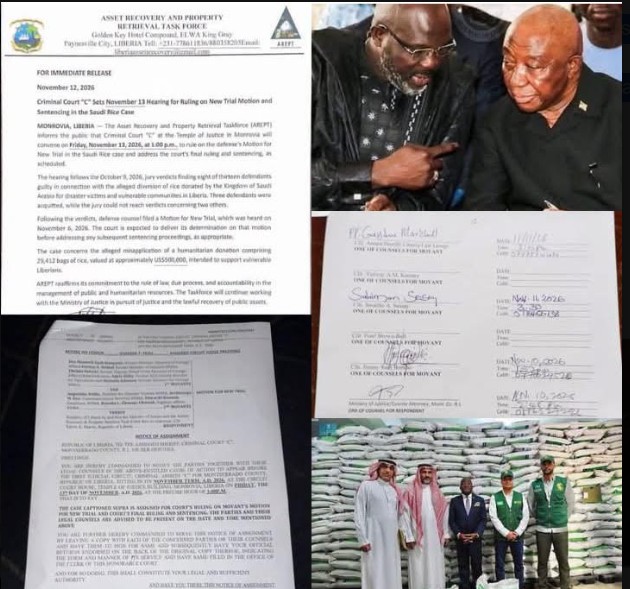
IPNEWS: Criminal Court “C” is scheduled to deliver a ruling on Friday, November 13, 2026, on a motion for a new trial in the high-profile Saudi Rice case involving former Foreign Affairs Minister Dee-Maxwell Saah Kemayah and 12 other defendants.
The proceedings follow an October 9 jury verdict in which eight of the 13 defendants were found guilty, three were acquitted, and the jury failed to reach a verdict concerning the remaining two.
According to a notice of assignment issued on November 10, the hearing is scheduled for 1:00 p.m. at the Temple of Justice in Monrovia, where the court is expected to address the defense’s motion before proceeding with any applicable final ruling and sentencing.
COURT TO DECIDE WHETHER NEW TRIAL WILL BE GRANTED
The defense’s motion for a new trial was heard on November 6, following the jury’s October 9 verdict.
The court’s upcoming decision will determine whether the request for a new trial is granted or denied.
If the motion is rejected, the court may proceed with the next applicable stages of the criminal proceedings, including final judgment and sentencing for defendants whose guilty verdicts remain in place.
However, if the motion is granted, further proceedings would be required in accordance with the court’s ruling.
The scheduled hearing therefore represents an important stage in a case that has attracted public attention because of the senior government officials involved and the nature of the donated humanitarian supplies.
FORMER MINISTERS AND GOVERNMENT OFFICIALS AMONG DEFENDANTS
The case involves several former and current government officials, including:
– Dee-Maxwell Saah Kemayah — Former Minister of Foreign Affairs.
– Varney A. Sirleaf — Former Minister of Internal Affairs.
– Thelma Sawyer — Former Deputy Director for Administration at the Ministry of Foreign Affairs.
Other defendants are also named in the proceedings, bringing the total number of accused persons to 13.
The October 9 verdict did not result in convictions against all defendants.
Of the 13 individuals, eight were found guilty by the jury, three were acquitted, and no verdict was reached concerning two others.
The supplied account does not identify which individual defendants fall into each category. Accordingly, the jury’s guilty findings should not be attributed to any particular named defendant without confirmation from the court record.
29,412 BAGS OF SAUDI-DONATED RICE AT CENTER OF CASE
The criminal proceedings concern 29,412 bags of rice valued at approximately US$500,000, donated by the Kingdom of Saudi Arabia to Liberia.
The donation was intended to provide humanitarian assistance to disaster victims and vulnerable communities.
The case centers on allegations concerning the handling and management of the donated rice.
The matter has raised questions about accountability in the administration of humanitarian assistance and the responsibility of public officials entrusted with managing donated resources.
However, the allegations and jury findings must be distinguished from the final legal outcomes, which remain subject to the court’s pending decisions and any applicable appeals.
ASSET RECOVERY TASKFORCE REAFFIRMS COMMITMENT TO ACCOUNTABILITY
The Asset Recovery and Property Retrieval Taskforce has reiterated its commitment to due process, accountability, and the lawful recovery of public assets.
The Taskforce’s position reflects the broader public interest in ensuring that resources intended for vulnerable populations are properly managed and that allegations of wrongdoing are addressed through established legal procedures.
At the same time, the judicial process must protect the legal rights of all defendants, including their rights to challenge verdicts and pursue remedies available under Liberian law.
FRIDAY’S HEARING COULD SHAPE NEXT STAGE OF PROCEEDINGS
With the court scheduled to rule on the new trial motion, attention will turn to whether the October 9 jury findings remain in place or whether additional proceedings will be ordered.
The decision may also determine whether sentencing can proceed for defendants whose convictions are sustained.
For the three acquitted defendants and the two individuals against whom the jury reached no verdict, their respective legal positions must be considered separately under the applicable court procedures.
The central issue before Criminal Court “C” on Friday is whether the defense has established sufficient legal grounds for a new trial.
As the proceedings continue, the case remains an important test of judicial due process and accountability in the handling of humanitarian resources.
