



By Amos Harris
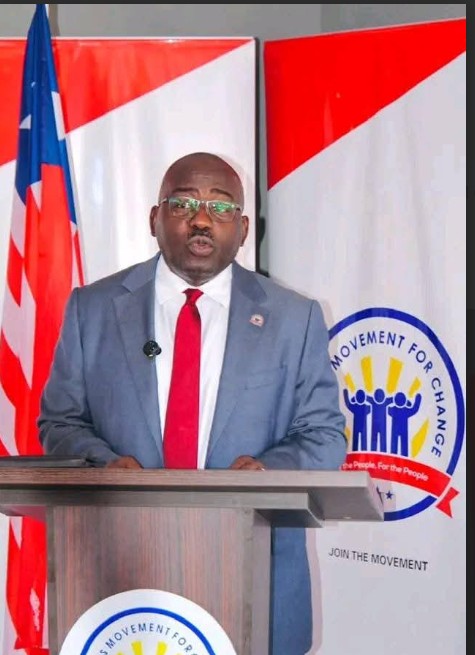
A major political controversy has erupted in Liberia following a damning fact-checking report that contradicts a public claim made by Musa Bility, political leader of the Citizens Movement for Change (CMC), that 80 percent of teachers in Liberia’s classrooms are volunteers.
The claim, which was made during a recent public engagement, has now been described as false and misleading by Local Voices, an independent media platform known for scrutinizing statements made by public officials and promoting accountability in governance.
According to the fact-checking institution, official data from the Ministry of Education does not support Bility’s assertion.
Instead, government statistics paint a markedly different picture of Liberia’s teaching workforce one that directly contradicts the narrative presented by the CMC leader.
The statement that sparked National Debate, Representative Bility, who also serves as lawmaker for Nimba County District #9, reportedly told supporters that the vast majority of teachers currently in Liberia’s classrooms are volunteers.
The statement quickly gained traction on social media and within political circles, fueling heated debate about the state of the country’s struggling education system.
The claim suggested that Liberia’s education sector is largely dependent on unpaid or informally employed teachers a scenario that would represent a severe institutional crisis and signal deep systemic failure.
For many citizens, the 80 percent figure painted a bleak portrait of a sector already grappling with limited resources, infrastructure gaps, and workforce challenges.
If accurate, it would have meant that only two out of every ten teachers are formally employed or paid by government or institutional payrolls.
However, the subsequent review by Local Voices has called that depiction into serious question.
What the data shows, in its published findings, Local Voices cited the Ministry of Education’s 2025 Annual School Census report as the basis of its analysis.
According to the official data, Liberia currently has approximately 61,300 teachers nationwide.
Of that number, 84 percent are classified as paid or regular teachers on government or institutional payrolls.
16 percent are listed as volunteer teachers, based on these figures, the fact-checking body concluded that Bility’s assertion that 80 percent of teachers are volunteers is incorrect and unsupported by official records.
“Local data from the Ministry of Education show that of the 61,300 teachers nationwide, 84% are paid or regular and 16% are volunteers,” Local Voices stated.
“Based on these findings, Bility’s claim that 80% of teachers in Liberia are volunteers is incorrect.”
The statistical gap between 16 percent and 80 percent is not marginal it is substantial.
Analysts say such a wide disparity raises serious concerns about the accuracy of public statements made by elected officials.
Silence and Missing Evidence
Notably, Representative Bility did not provide any documentary evidence, official report, or survey to substantiate the 80 percent figure during his remarks.
No reference was made to ministry data, independent research, or statistical analysis.
Political observers argue that when addressing matters of national importance particularly in a sector as sensitive as education leaders carry a responsibility to ensure that their statements are grounded in verifiable facts.
Education remains one of the most critical pillars of Liberia’s post-war recovery and long-term development agenda.
The sector receives support from international partners, development agencies and donor institutions that rely heavily on credible data to guide funding decisions and program design.
Critics say that presenting exaggerated figures could distort public understanding, mislead stakeholders, and potentially undermine confidence in the system.
As of press time, Bility had not publicly responded to the findings of the fact-checking report, nor had he clarified the source of the 80 percent claim.
Mixed public reaction,
public reaction to the controversy has been divided.
Supporters of the CMC leader argue that he may have been attempting to highlight genuine structural challenges facing teachers across the country, particularly in rural areas where volunteerism may appear more common.
Others, however, insist that leadership demands precision.
“Leaders should speak with facts,” said Madam Josephine Nimely during an interview with journalists.
“When you are addressing the public, especially on issues affecting our children and the future of this country, you must come prepared with correct information.”
She emphasized that fact-based communication is essential for building public trust.
“Speaking with facts sets an example for good leadership for the next generation,” she added.
Her comments echo a growing sentiment among citizens who believe Liberia’s political culture must shift toward evidence-driven dialogue rather than rhetorical exaggeration.
Volunteer teachers, a real but smaller challenge, while the fact-checking report discredits the 80 percent claim, experts caution against dismissing the volunteer teacher issue altogether.
Sixteen percent of 61,300 teachers amounts to roughly 9,800 individuals working without regular government pay or formal employment status.
Education advocates say this is still a significant number and points to gaps in workforce planning, budgetary allocation, and teacher recruitment systems.
The presence of nearly ten thousand volunteer teachers suggests that certain regions may still face staffing shortages or delays in formalizing employment contracts.
However, analysts warn that overstating the scale of the problem may create unnecessary alarm, particularly among international donors and development partners who depend on accurate statistics to guide financial commitments.
“Exaggeration can be just as harmful as denial,” one education policy observer noted.
“If the data shows 16 percent, then that is the number policymakers must work with.”
The growing role of fact-Checking in Liberia
The episode underscores the increasing influence of independent fact-checking institutions in Liberia’s evolving democratic landscape.
Platforms like Local Voices are emerging as key players in verifying public claims and ensuring that political narratives align with documented evidence.
Political analysts argue that fact-checking should not be interpreted as hostility toward politicians but as a strengthening of democratic accountability.
“When leaders are corrected with data, it improves public discourse,” one political analyst observed.
“It encourages responsibility and raises the standard of public debate.”
In recent years, Liberia’s political environment has seen heightened scrutiny of public statements, particularly in areas involving public spending, social services and governance reforms.
The controversy surrounding Bility’s statement may further entrench expectations that elected officials must substantiate their claims with credible data.
Broader Implications for Governance, beyond the immediate political fallout, the debate reveals a deeper governance challenge, the urgent need for fact-based leadership in Liberia.
As the country continues its journey toward democratic consolidation, institutional strengthening, and economic recovery, the credibility of public information remains paramount.
Inaccurate statistics whether intentional or accidental can erode trust, polarize debate, and shift attention away from constructive solutions.
The discussion over volunteer teachers may appear technical, but it carries symbolic significance.
It highlights the responsibility of elected leaders to inform rather than inflame, to clarify rather than confuse.
For a nation striving to rebuild confidence in public institutions, accuracy is not optional it is essential.
Awaiting Clarification
It remains unclear whether the 80 percent claim was based on outdated data, anecdotal observations from specific communities, or a miscalculation.
Some analysts suggest that politicians often rely on localized experiences, particularly in remote areas where volunteer teachers may be more visible.
However, translating such experiences into national statistics without verification can lead to misleading conclusions.
Whether Representative Bility will issue a clarification or correction remains to be seen.
What is clear, however, is that the fact-checking investigation has firmly established that the claim does not align with official Ministry of Education data.
With 84 percent of teachers reportedly on payroll and 16 percent serving as volunteers, the available evidence contradicts the narrative presented during the CMC leader’s public engagement.
For many Liberians, the controversy is about more than a single statistic.
It is about standards standards of truthfulness, accountability, and responsible leadership.
In today’s Liberia, public statements are no longer taken at face value.
They are examined, verified, and, when necessary, challenged, as scrutiny intensifies and democratic expectations evolve, one lesson stands out, facts matter.
And in shaping the future of Liberia’s children and its education system, they matter more than ever.
