



—As Joint Team Completes Tour at GLS Facilities
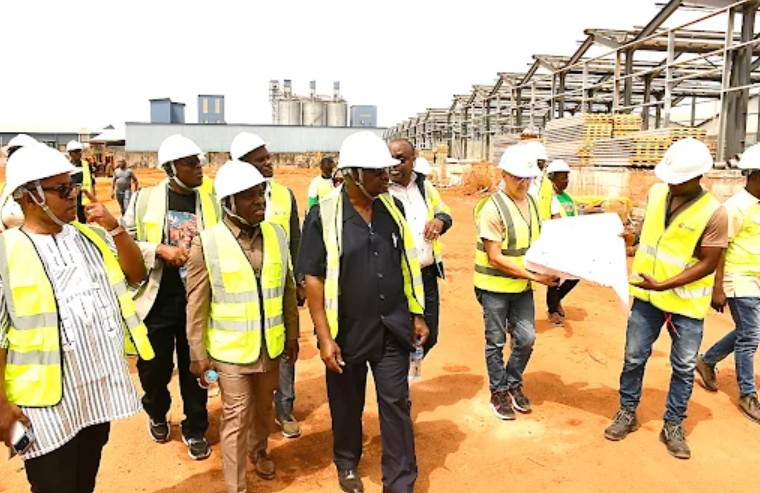
IPNEWS: A high-level delegation of lawmakers and Cabinet ministers has toured Liberia’s new Destination Inspection (DI) Facility under construction at the Freeport of Monrovia, signaling strong political backing for what authorities describe as a transformative step in revenue generation and economic reform.
Led by Commissioner General James Dorbor Jallah of the Liberia Revenue Authority (LRA), the inspection brought together members of the Ways and Means Committees of both Houses of the Legislature, alongside senior Cabinet officials, to assess progress on the modern facility expected to be completed in August.
Before visiting the new site, the delegation toured the existing DI facility, where spatial congestion and operational constraints highlighted the urgency of modernization. The contrast reinforced the government’s argument that infrastructure upgrades are critical to combating under-declaration, smuggling, and revenue leakages at Liberia’s primary port of entry.
“This modern DI Facility will significantly enhance our intrusive and non-intrusive inspection capabilities, improve efficiency at the Port of Monrovia, and strengthen revenue performance,” Commissioner General Jallah said. “Our objective is to align Liberia’s port operations with modern international standards of transparency and trade facilitation.”
At its core, the DI project is about strengthening customs enforcement and domestic resource mobilization. Liberia has long struggled with revenue shortfalls, particularly in customs collections, which account for a significant share of national income. Weak inspection systems, limited scanning technology, and manual verification processes have historically created loopholes for misdeclaration and corruption.
The new facility will incorporate a comprehensive cargo scanning system capable of determining the contents of containers with greater precision. This technology reduces reliance on discretionary manual inspections, a practice often vulnerable to manipulation and rent-seeking behavior.
Bong County Senator Prince Kermue Moye described the development as a turning point for Liberia’s revenue agenda.
“Once you have machines that determine the content of containers, importers will fully declare,” Senator Moye stated. “With that discipline in place, we are assured that our revenue targets will continue to move forward.”
Revenue experts note that effective destination inspection systems serve two main functions: verifying the accuracy of cargo declarations and deterring fraud through technological transparency. By introducing automated scanning and standardized inspection procedures, Liberia is seeking to close the gap between projected and actual customs revenue.
The high-level legislative presence at the site also underscores the financial implications of the project. Lawmakers hold appropriation and oversight authority, and their public endorsement signals confidence in the LRA’s capacity to deliver measurable revenue gains.
“Revenue performance does not happen by magic — you must empower the institution responsible for delivering it,” Senator Moye emphasized. “When we see an institution performing and meeting expectations, we must take it seriously.”
The delegation included Grand Bassa County Senator Gbehzohngar Findley, Gbarpolu County Senator Botoe Kanneh, and River Gee County Representative Johnson Williams, along with Justice Minister N. Oswald Tweh and Transport Minister Sirleaf Tyler.
Their participation suggests that the DI facility is not merely a technical customs project but a central pillar of the government’s broader fiscal reform strategy under President Joseph Nyuma Boakai.
Public-Private Partnership and International Standards
The facility is being implemented under a Destination Inspection Agreement between the Liberian government and Medtech Scientific Dubai through MTS Inspection Services Ltd, a Special Purpose Vehicle (SPV). According to Attorney Oliver N. Rogers II, CEO of MTS Inspection Services Ltd, construction is progressing on schedule.
“The ongoing construction has recorded substantial progress in line with the established Construction Execution Plan,” Rogers said. “We remain firmly on schedule, and the facility is expected to be completed and ready by August this year.”
Construction is being executed by Family Pol Business (FPB), an Italian-owned domestic corporation, with supervision by Design Engineer Partner (Dubai) in collaboration with the Ministry of Public Works. The layered supervision structure, officials say, is designed to ensure compliance with technical standards and prevent cost overruns.
This public-private model reflects Liberia’s effort to leverage international expertise while maintaining national oversight — a balancing act critical to building investor confidence and institutional credibility.
Beyond revenue collection, the DI facility carries implications for economic revitalization and trade efficiency. A modern inspection system can significantly reduce cargo clearance times, minimize port congestion, and lower transaction costs for importers and exporters.
For a country seeking to stimulate private sector growth and attract foreign direct investment, efficient port operations are essential. Delays and unpredictability at customs not only increase costs for businesses but also discourage regional trade competitiveness.
By aligning port operations with international trade facilitation standards, Liberia positions itself as a more predictable and transparent trading partner within the West African region. Improved compliance and streamlined processes could also enhance Liberia’s standing in global trade rankings, potentially attracting logistics and manufacturing investment.
The high-level tour itself carries symbolic and practical significance. Symbolically, it demonstrates unity between the Executive and Legislative branches in prioritizing revenue reform. Practically, it signals oversight commitment — lawmakers are publicly associating themselves with the project’s success.
In governance terms, such visibility reduces the likelihood of policy reversal and strengthens institutional continuity. When legislators witness progress firsthand and publicly endorse it, they create political capital that can sustain funding and policy support over the long term.
For the LRA, the moment represents institutional validation. Historically criticized for revenue gaps and systemic inefficiencies, the Authority now appears to be repositioning itself as a reform-driven agency focused on technology, transparency, and measurable outcomes.
Domestic revenue mobilization is widely regarded as the backbone of sustainable development. With limited fiscal space and heavy reliance on external financing, Liberia’s ability to fund infrastructure, education, healthcare, and security depends largely on improving tax and customs collection.
If the new DI facility successfully reduces under-declaration and enhances compliance, it could significantly boost government income without imposing new taxes — an outcome politically and economically advantageous.
Commissioner General Jallah reiterated that the facility is designed to “strengthen domestic resource mobilization in line with national development priorities.”
Ultimately, the success of the project will depend on consistent enforcement, data-driven monitoring, and resistance to political interference. But for now, the high-level tour signals that revenue reform has moved from policy rhetoric to visible infrastructure—an indication that the government is betting heavily on institutional modernization as a pathway to economic recovery and long-term national development.
