



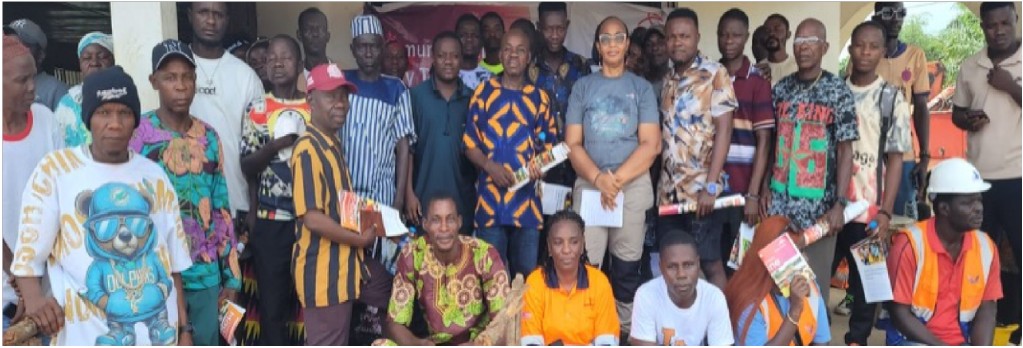
IPNEWS-COMPOUND #3, Grand Bassa County: ArcelorMittal Liberia (AML) is stepping up efforts to prevent railway-related accidents through community education, engaging residents of Compound #3 in Wee Statutory District, Grand Bassa County, in a dialogue on the dangers of unsafe behavior around active railway lines.
The engagement brought together residents, youth leaders, traditional authorities, local government officials and representatives of the Liberia National Police (LNP) to discuss practical ways of protecting lives and preventing accidents along the Yekepa-Buchanan railway corridor.
The initiative reflects AML’s continued efforts to strengthen public understanding of railway operations and encourage safer behavior among communities living and working near the tracks. As railway operations continue along the corridor, the company says public awareness and community cooperation remain essential to reducing avoidable accidents.
Organized by AML’s Sustainability and External Relations Department in collaboration with the Liberia National Police, the engagement provided an opportunity for residents to receive safety information, raise concerns and discuss the responsibilities of individuals and communities in protecting lives around railway infrastructure.
Community Relations Manager Vaanii Kiazolu II emphasized that railway safety cannot be achieved by the company alone but requires the active involvement of everyone living along the corridor.
“Protecting lives along the railway starts with awareness and responsible behavior,” Kiazolu said. “We want every resident to understand the risks and make safe choices that help prevent accidents in our communities.”
He encouraged residents to take the safety messages beyond the meeting by sharing them with family members, friends and neighbors, particularly children and young people who may not fully understand the dangers associated with active railway lines.
AML Deputy General Manager for Rail, Mulbah Gbozee, provided an overview of railway operations and explained why strict adherence to safety regulations is necessary whenever trains are approaching or moving through populated areas.
He cautioned residents against walking or playing on railway tracks, crossing at unauthorized locations, placing objects on the tracks or engaging in other activities that could expose them to danger.
“Trains cannot stop immediately when an obstacle is detected on the tracks,” Gbozee explained. “That is why it is critical for community members to stay off the railway and remain alert at all times around active rail operations.”
His remarks highlighted an important aspect of railway safety: unlike road vehicles, trains require considerable distance to slow down and stop. This makes it particularly dangerous for pedestrians to assume they can cross the tracks quickly enough when a train is approaching.
The engagement also emphasized the importance of keeping children away from railway tracks and ensuring that young people understand that railway infrastructure is not a playground or a safe place to gather.
Representatives of the Liberia National Police and local authorities reinforced the company’s safety messages, urging residents to respect railway restrictions and report dangerous activities that could result in accidents. They also encouraged community leaders to make railway safety a regular subject of discussion at local meetings and within their respective communities.
The participation of law enforcement and traditional authorities underscored the importance of cooperation between the company, government institutions and residents in maintaining safety along the railway corridor.
AML’s delegation included representatives from Community Relations, Rail Operations, Security, Health and Safety, and Communications. Their participation reflected a coordinated approach to railway safety, combining operational knowledge, public education, security awareness and direct community engagement.
The Compound #3 dialogue is part of AML’s broader community rail safety program, which uses several communication channels to reach residents across communities along the Yekepa-Buchanan railway line.
These activities include public education campaigns, radio outreach, community meetings, school engagements and the company’s annual Rail and Road Safety Caravan. Through these initiatives, AML seeks to ensure that railway safety information reaches people of different ages and backgrounds, including residents who may have limited access to formal safety education.
Community participants welcomed the engagement, describing the discussion as an opportunity to better understand the risks associated with railway operations. They pledged to work with AML, local leaders and law enforcement authorities to share the information and encourage safer practices within their communities.
The involvement of residents is particularly important because railway safety extends beyond the tracks themselves. Daily activities around railway crossings, settlements and other points along the corridor can create risks when people are unaware of train movements or disregard established safety precautions.
For AML, sustained engagement with communities remains an important part of its responsibility to operate safely while maintaining constructive relationships with people living along the railway corridor.
By combining public education, operational guidance and partnerships with local authorities, the company continues to promote a culture of shared responsibility aimed at preventing accidents and protecting lives along the Yekepa-Buchanan railway.
