



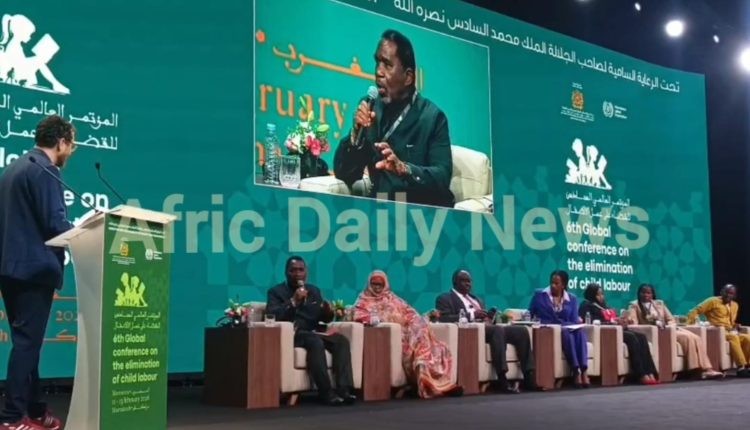
IPNEWS: Liberia Labour Minister Cllr. Cooper W Kruah Sr. has renewed Liberia’s commitment to the global fight against child labor, as he addressed an international conference in the Kingdom of Morocco focused on eliminating the practice worldwide.
The conference brought together senior officials, including Morocco’s Minister of Economic Inclusion, Small Business, Employment and Skills, H.E. Younes Sekkouri, representatives of the International Labour Organization (ILO), officials from the African Cooperation and Moroccan Expatriates Directorate, United Nations agencies, international organizations, and members of the diplomatic corps and media.
Delivering remarks at the gathering in Rabat Conference, which ran from February 11-13, 2026, the Labour Minister described child labor as the exploitation of children through work that interferes with their education or is mentally, physically, socially, or morally harmful.
He said, while certain forms of light work, such as supervised training, family duties, or artistic performances, may be legally permitted, hazardous and exploitative labor remains prohibited under international conventions and national laws.
Minister Kruah emphasized that child labor remains a complex and multifaceted issue driven by several interconnected factors:
Poverty and economic hardship: Families in extreme poverty often depend on children’s earnings for survival.
Limited access to quality education: Where schooling is unavailable, unaffordable, or of poor quality, parents may prioritize work over education.
Conflict, crises and natural disasters: Armed conflict, famine and environmental disasters disrupt social systems and force children into labor, trafficking or even armed groups.
Cultural norms and traditions: In some communities, child work is seen as a rite of passage or character-building exercise.
Limited adult employment opportunities: A shortage of decent jobs for adults increases reliance on cheaper child labor.
Weak law enforcement: Even where laws exist, limited inspections, corruption and low prioritization hinder enforcement.
Gender discrimination: Girls are disproportionately engaged in domestic labor and are often denied access to education.
Migration and displacement: Refugee and migrant children are particularly vulnerable to forced labor and trafficking.
Debt bondage: Children may be compelled to work to pay off family debts.
Demand for low-cost labor: Employers in informal sectors such as agriculture, mining and manufacturing sometimes exploit children to reduce costs.
“Child labor is not only a consequence of poverty,” Kruah noted. “It also perpetuates poverty by depriving children of education and trapping future generations in hardship.”
The conference underscored that eliminating child labor is critical to upholding fundamental human rights, ensuring child safety and advancing sustainable development.
According to international estimates, approximately 138 million children worldwide remain engaged in labor, including 54 million in hazardous work. Although progress has been made in recent years, global efforts have fallen short of the initial target to end all forms of child labor by 2025.
Key benefits of eliminating child labor include:
Protection of human rights and safety: Children are shielded from hazardous conditions in sectors such as mining and agriculture.
Economic growth and poverty reduction: Removing children from exploitative labor creates opportunities for decent adult employment and increases long-term productivity.
Breaking the cycle of poverty: Education equips children with skills needed for sustainable livelihoods.
Gender equality: Targeted interventions help reduce the disproportionate burden on girls in domestic and informal labor.
Improved social outcomes: Education improves health, well-being and future earning potential.
Call for Stronger Global Action
Labour Minister Kruah called for strengthened legal frameworks, improved labor inspections, expanded access to quality education, and enhanced public-private partnerships to combat child labor. Reference was made to international initiatives aimed at promoting ethical supply chains and sustainable production practices.
“Eradicating child labor requires coordinated global action and sustained political will,” the address emphasized. “We must prioritize the elimination of its worst forms while accelerating efforts to protect every child’s right to education, dignity and opportunity.”
Liberia reaffirmed its commitment to working alongside international partners to safeguard children and promote inclusive, sustainable development across Africa and beyond.
Historically, child labor was widespread during the 19th and early 20th centuries, when children from impoverished families worked in agriculture, factories, mining and domestic service, often under harsh and dangerous conditions. Over time, rising household incomes, expanded access to education, and the passage of labor laws significantly reduced its prevalence in many parts of the world.
