



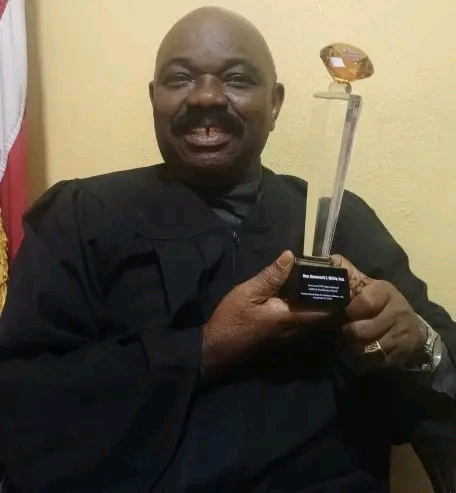
—-Says Failure to Dispense Justice Based on Rule of Law Could Return Liberia to Failed State Status
IPNEWS: Criminal Court ‘A’ and assigned judge of the 13th judicial circuit in Margibi County His Honor Roosevelt Z. Willie has issued a stinging reminder that the Liberian Justice System was one of the root causes of the country’s 14-year civil war, and questioned whether the system has truly learned from its past.
Delivering his Judges’ Charge for the November Term of Court A.D. 2026 on Monday in Kakata, the Liberian international-award winning Judge Willie recalled a damning 2006 report by the International Crisis Group (ICG).
“Few years ago, exactly August 12, 2019, I delivered a charge in this same very Court and quoted the Report of the International Crisis Group (ICG), which stated that the Justice System was one of the root causes of the Liberian Civil War,” Judge Willie told the gathering.
According to Judge Willie, the ICG Report described the Judiciary, the Police and Correction Centers as “very corrupt” and specifically identified the Judiciary as being subservient to the National Legislature.
“It specifically identified the Judiciary as being subservient to the National Legislature and had to practically beg for its allotted portion of the budget before it could function,” he quoted the ICG report as saying.
The Judge explained that the impact was devastating lack of decent courthouses, employment of mostly non-lawyers as Judges and semi-educated Magistrates, and low wages that made justice favor only those with deeper pockets.
“These Judges, Magistrates and support staff were paid low wages and so, justice dispensed favored only those who had the deeper pockets; since those responsible for administering justice had to compensate for their cost,” the 13th Judicial Circuit Court Judge stated.
He further quoted that Police and Prison personnel received illegal funds, detention facilities were overcrowded, and the rights of convicts and pre-trial detainees were abused.
Reforms Since 2006
Judge Willie, however, acknowledged that important strides have been made since the Judiciary’s first Strategic Plan crafted in Accra, Ghana in 2011.
He named key reforms including the enactment of the Judiciary Financial Autonomy Act, which allows the Judiciary to prepare its own budget that cannot be altered by the Executive, the construction of Judicial Complexes, increased wages for judges and staff, and the establishment of the James A. A. Pierre Judicial Institute (JI) in 2008.
Other reforms he listed include the Magistrate Sitting Program and the Public Defense Program to provide legal representation for indigent criminal defendants.
“Therefore by implication, we have been empowered to some extent to perform our judicial functions,” Judge Willie noted.
Despite the reforms, Judge Willie posed a challenging question that formed the theme of his charge: HAS THE LIBERIAN JUSTICE SYSTEM LEARNED FROM ITS PAST HISTORY, PRIOR TO THE CIVIL WAR?
Delivering the charge before the Honorable Superintendent of Margibi County, the leadership of the Margibi Bar Association, the National Association of Trial Judges of Liberia, the Public Defense Department, Members of the Fourth Estate, Prospective Jurors and distinguished ladies and gentlemen, Judge Willie warned that Liberia must not return to its dark past.
He recalled his own 2012 paper presented at the 44th Annual Conference of the Liberia Studies Association (LSA) at Cornell University in Ithaca, New York, under the theme:
“BUILDING A CAPABLE STATE, LOOKING BACK, MOVING FORWARD IN LIBERIA’S DEVELOPMENT,” where he argued that:
“Any country that does not learn from its past is doomed to fail and cannot develop.”
Judge Willie concluded with a strong admonition to all justice actors:
“However, the question still lingers on as to whether those of us who are privileged to serve in the Justice System, particularly the Judiciary, have learned from our past history or mistakes that led to the fourteen (14) year civil conflict! … One thing is certain in the dispensation of justice for us not to return to a ‘failed state’, and that we should dispense justice based on the rule of law; irrespective of religious, political, economic or social status.”
The November Term of Court was officially opened in Kakata following the Judge’s charge.
